Showing posts with label simplicity. Show all posts

Sunday, January 10, 2010

Step 10: A Place to Go

"I learn by going where I have to go." ~ Theodore Roethke in the Poet's Corner at The Cathedral of St. John the Divine

I keep a wipe board in my apartment that tracks my to-do's for my projects. This confined space helps me to sort out where and how I'm spending my time and energy. It's a helpful, simple tool that keeps me on track by giving me a very concrete visual of my priorities. It tells me where I have to go to create the kind of life I want.

In 2010, this chart has been heavily influenced by Innovation Station, my after-school project with Citizen Schools. With Citizen Schools, citizen teachers build the curriculum backwards, starting with the construction of the final project, called a "WOW", and working the lessons backwards with the final project always in mind. Rather than using the forward-working paradigm of "what comes next?", I have to start with "what needs to happen right before the WOW?" I decided to try this approach with my wipe board, too. On the far right side I wrote down the goal, and then only included the projects in my life right now that work toward that goal.

This exercise helped in a number of ways:
1.) I have some projects in my life that aren't serving that goal, and they didn't make it to the wipe board. These projects have value; they just aren't the right projects for me given my goals and in comparison to the other projects I have. I also noticed some very clear holes - things I needed to be doing, places I needed to be going, that I didn't realize before this process.

2.) I breathed a great big sigh of happiness to see how the projects all fit together and support one another. A cohesive plan breeds confidence and conviction.

3.) Having the plan laid out gave me a lot of energy. I spent a lot of time carefully thinking through options and allowing them to play themselves out in my mind while I made some key decisions. With this plan laid out, I freed up the energy that I was using in the decision-making process.

4.) The plan provides me with more down time to be with people. These projects lay out the main interests of my life, and by knowing those interests, I can strengthen relationships I already have and start new ones based on commonalities. I am always inspired by feats that people can accomplish through collaboration. Having a very clear sense of what we want to accomplish helps us to meet others who have those same goals - our kindred spirits.

5.) The wipe board gives me a place to go. There will always be new opportunities and new projects that will appear. It can be hard to say no. With a clear sense of what I want, I can go to the board and see where the new opportunity fits. If it doesn't fit, then the decision process is made that much easier. It's an effective sorting method.

Clarity of mind gives us a wonderful sense of freedom, a radiance that we can feel and that others can see. By working toward clarity, decisions become easier. The tough work of getting to clarity is well-worth the reward of simplicity.

Monday, October 19, 2009

My Year of Hopefulness - Sunsets and Moments

The brilliant women over at Owning Pink made one of my recent posts to their blog their homepage this morning. I'm honored and humbled. Thanks to Keith for inspiring this post. From the comments on the original Owning Pink blog, it helped a lot of people. It's an amazing gift to be able to write things that help others - especially since this writing helps me so much.

"On Saturday afternoon as I was walking back to my apartment, I came around the corner and saw this amazing sunset, one of the most beautiful I had ever seen. I raced upstairs to my apartment, grabbed by camera, and jumped out the window to snap a photo of it. And you know what? It didn’t work. No matter what settings I changed on my camera, I just couldn’t get the photo of the sunset to look the way it actually was. My eyes saw something so much more beautiful than my camera could capture and hold.

So all I could do was stand there on the roof, basking in the glory of all those colors. As the sky turned darker, the sunset got more and more beautiful. The colors evolved and mingled and every moment was more incredible than the moment before. Our lives are like that, too, so long as we just let them unfold in their own time, in their own way.

With every experience, our lives grow richer, each one adding its own little dab of color. I know that all of the things I’m working on now are little dabs, and they might not seem like they belong together just yet. I know that they will find a way to work together, and that eventually the art of my life will emerge. That will happen for all of us. It’s not a matter of if, just a matter of when. Our only job is to show up every day, for ourselves and for the people we love, and let life unfold moment by moment.

Today someone sent me an amazing video from Radio Lab about moments. http://blogs.wnyc.org/radiolab/2009/08/14/16-moments/

I love it so much that I’ve played it over several times now. It features the moments of every day life, mostly things we take for granted. As I watched the video I became even more aware that these little moments, the things we don’t or can’t capture and hold, are the building blocks of our lives. While mostly simple and ordinary this is the stuff of our days. It reminded me that there is always time and cause for celebration.

In what ways can you slow things down, just a little? What is there to notice? How might it change the way you live, love, and celebrate?

Watching it all unfold,
Christa"

Wednesday, September 16, 2009

My Year of Hopefulness - Living With Less

My friend, Laura, and I have made a pact of simplicity, a promise to keep each other on the path of less is more. My apartment's furniture consists of a yoga mat, my friend, Jamie's, air mattress, and a couple of IKEA plastic chairs that I plan to use on my little patio. It's sort of like camping indoors. I lie awake at night staring out the windows at the beautifully illuminated view, and I say a little prayer in the hopes that I will always feel this content.

I don't know that I've ever been happier with the decor of an apartment. In my old apartment, I was in such a rush to get it "perfect". I actually made that statement out loud several times and each time it felt wrong. Now that I think back on that old apartment, there was always something just a bit off about it. I felt shut in despite all of the space. Now with less room in my new apartment and fewer belongings I feel a freedom that I don't think I've ever felt before at home.

On Tuesday I saw my first sunset from my patio. I face west toward the Hudson River and my view is dotted with those beautiful water towers that are found everywhere in New York City if we turn our gaze upward. The sky was a deep ruby red and lined with puffy clouds that took on a dusty blue hue as the sun sunk down behind New Jersey. There's an odd, comfortable feeling of belonging in this new space. I can't explain it except to say that it feels just right, imperfect and unfinished.

My life prior to this most recent move was too full. I felt too obligated, too burdened, a little claustrophobic and over-committed. I just didn't know how to simplify, how to free up my energy and my time. Now that I am through the stress of the most recent events, I am searching for every bright side possible. I'm too grateful for today, for every day, to not look for the bright sides. I'm turning over every stone to make sure I find as much happiness as possible.

In the past few days, I've found myself more relaxed and at ease, reluctant to rush or buy much of anything, reluctant to give away my time and space for anything less than those people and things that I truly, truly treasure. It's a sweet feeling to be surrounded only with what fills us up with joy.

Friday, September 4, 2009

My Year of Hopefulness - My Mother Makes Room

"The only real elegance is in the mind; if you've got that, the rest really comes from it." ~ Diana Vreeland

Today my mom began the slow and sometimes painful process of emptying. My mom is an extremely skilled collector, meaning that she never, ever gets rid of anything or anyone. She likes to be surrounded, with things, with people. It gives her comfort and she's always had in mind that eventually someday she'd get to that magazine, or that book, or that craft project or conversation she was meaning to have. And someday she'll get to some of them, but truthfully, she won't ever get through all of it. There is 35 years of stuff in her house and today it was time for a good chunk of that stuff to go.

I've been thinking about this process of emptying, wiping the slate clean, and beginning again. It's a task best done often and thoroughly. It's amazing what piles up in our homes, lives, and minds. Even in our writing. I've tried to approach my own process of emptying with an attitude of elegance. Consider modern design, of anything really. Clean lines, simplicity, removing the unnecessary so the necessary can speak. I'm trying not to think of it as throwing out, but making room to breath and to move.

While on the surface all this emptying sounds like it would be a great relief, as if a huge weight has been lifted from us, I must confess that in some ways it is a bitter sweet relief. My mom had to let go of a lot of memories in order to make that room in her home. She had to recognize that certain parts of her life are gone. It's a brave thing she did - to let go. There are so many people who never do that, who can never face up to the fact that life is moving by at a very quick pace, and that sometimes there are some things that must be let go of. We can't possibly hang on to it all.

My mom is an elegant woman - she has handled far more than her fair share of obstacles and disappointments. She's suffered huge losses of many things and people, losing some after many hard fought struggles, and through it all she worked hard to keep a face of elegance and grace. She got through it by putting her mind in order and saying that right now she just needs to get from A to B, and tomorrow she'll consider getting to C. We were her first priority always, no matter what, so I guess that made some decisions easier to make. She was never going to do anything that wasn't good for her kids. She is by every definition an elegant mother.

So now as she enters the autumn of her life with a less full home in every sense, she has the room and space to decide how to place what remains. And though now it may look like there are unnatural holes and pockets, my guess is that she will find a way to make it all fit together. By removing what was no longer needed, she uncovered and rediscovered lost treasures and memories and ideas, things that will enrich her life going forward. It will just take some time to get used to.

Wednesday, July 1, 2009

My Year of Hopefulness - Clay Pots

I was witness to a conversation today that round and round in circle so many times that I began to feel dizzy. The two parties couldn't get out of their own way, despite the fact that both were seeking a common goal. The more they talked, the more complicated and convoluted the conversation became. It was a welcome relief to then dive into the book The Pursuit of Elegance and learn about Mohammed Bah Abba's clay pots.

Recognizing that subsistence farmers in Nigeria needed a way to keep fresh produce from spoiling so quickly, he took a common object in Nigeria, clay pots, and combined with a little middle school science to build a refrigeration device. Abba put one clay pot inside another larger clay pot, packing wet sand in between the two. Then, he placed a wet towel over the inner pot and let the science of evaporation do its work. As the water evaporates, it cools the inner pot, and any contents stored inside that pot. Farmers could preserve their produce longer to increase their sales at the market, raising income for those farmers and their families, spurring all of the positive side effects in a community as wealth increases.

So simple. Clay pot, sand, basic science principles. When cobbled together by Abba's creative mind and sense of empathy, these three things transformed a community. Abba's business has expanded throughout Nigeria and into other Africa countries. Abba saw a problem, took what he had, and crafted an elegant solution that could be made available to many at a very low cost. So simple, it make us wonder why it wasn't thought of earlier.

Abba's story made me re-consider the conversation I witnessed earlier today. It made me consider the importance of clarity of vision and the value of a solution that combines design and function in a simple, elegant fashion. And the equation to get to this type of solution isn't complex. Ask three questions: What are we trying to solve for? What assets do we have available to us? How can we use those assets to transform what we've got into what we need?

The photo above can be found at: http://www.treehugger.com/files/2006/08/mohammed_bah_ab.php

Tuesday, June 23, 2009

My Year of Hopefulness - Jackson Pollack, Explained

I was in DC a few weekends ago and met up with a bunch of friends from business school. One member of the group who is more a classmate than a friend of mine criticized Jackson Pollock and his work, citing that even he could drip a bunch of paint on a canvas. (And this guy doesn't have an artistic bone in his body!) At the time, I had no words to explain Jackson Pollock, and I was really upset by the guy's criticism. I like Pollock's work very much, though must confess I never understood it. I just love the patterns, colors, and textures of it.

As luck, and karma, would have it, today I found out why I love Jackson Pollock. If only I had read Matthew May's book In Pursuit of Elegance before my DC trip! May explains the genius of Pollock's work, thanks to the research of Richard Taylor, a physicist from Australia.

After studying Pollock's work in connection to his physics research, Taylor recognized that Pollack built his paintings based upon fractals: "repetitive patterns nested within each other that remain the same at differing scales of magnification...[fractals] are simple rules...that create beautifully organized and highly complex designs [that are pleasing to the eye]." Trouble is Pollock died in 1956 and fractals weren't discovered until 1975. Pollack lived and died ahead of his time, precisely 19 years ahead of his time.

I have been thinking about fractals all evening, their importance to physics, to Pollock, and to every day life. In a very real sense, our core values are fractals: repeating patterns that remain constant, even when examined up close. We don't abandon them at our front door or in certain company. They stay with us and play themselves out in every area of our lives. From those simple values (aka, simple personal rules) - honesty, kindness, loyalty - we build complex, intricate relationships that form the very foundation from which all our life experiences grow. Fractals make art, and life, appealing to the eye, the mind, and the heart.

Lest we think that life is all about politics and facades and putting on airs - it is not. Life is about getting down to the simple matter of what matters to us. At the end of the day, what really counts? What do we want to be known for? What are the constants that underlie who we are, under all circumstances? It's those things, those constant, consistent patterns, and their intersections that help us build beautiful lives.

The image above is of Blue Poles by Jackson Pollock. It recently sold for $40M.

Sunday, October 19, 2008

Growing by Shrinking

We're in the midst of watching our economy contract. These are frightening times, uncertain times for many people. I was inspired by Nicholas Kristof's column this week as he attempted to find a bright spot in all the gloom that is filling our news channels and our own minds. I was flipping through Business Week and saw an ad for IBM with the following headline in bold type: "Sometimes Growing Starts With Shrinking". How can we connect Kristof's ideas and the IBM ad? 

Aside from our economy, I have been thinking about examples of shrink leading to growth. The ipod - making our music libraries physically shrinking from 100's or 1000's of albums, tapes, and CDs into one powerful device helped Apple find new life. The same can be said of many electronics such as cell phones and computers. 
 
Let's consider travel. There have been a myriad of articles that encourage travelers to select a few key cities for a vacation and take in all they have to offer rather than doing a whirlwind trip and only skimming the surface of many cities. It creates more powerful and lasting memories, not to mention providing for some relaxation - the whole purpose of many vacations. 

Another example that struck me was all of the research being done now on multi-tasking. By attempting to do many things at once, it turns out that we do all of them more poorly than we could if we focused on one at a time. I notice this all of the time at work as I'm trying to balance a whole host of projects and objectives. Some studies even show that a lack of focus caused by multi-tasking increases stress levels, worsening general health levels, and lowering IQs.    

Now consider our economy: Think about the benefit of shrinking our spending to increase our savings. Barry Schwartz talks about shrinking the number of options we consider as a means of being happier with the choices we make. And then one of my favorite mantras can bring an immeasurable amount of peace to your life: simplify, simplify, simplify.

All of this is meant to show that shrinking isn't always bad and can even be good for us if we're willing to put aside our belief that bigger and more always equals better. Sometimes doing and having less provides abundance in ways we never expected.   

Monday, September 29, 2008

The agony of confusion and the ecstasy of clarity

By nature, I'm a passionate person. There are a few subjects that really get me going - happiness, creativity, health and wellness, the environment, puppies. (Not necessarily in that order.) And simplicity - I'm big on that. If we all worked on making our world and our lives simpler, we would all be better off. In some circles complexity and confusion are celebrated, relished, even chased because it's a mark that what those people in those circles are doing is "very important" if no one else can understand it. How ridiculous, not to mention wasteful - something we can no longer afford to be in our economic situation. 

I was shocked to hear the news today that the House didn't pass the "bailout". The Dow tumbled along with stock prices of major companies, and panic is spreading, slowly and quietly. It's unsettling. Someone said to me today that she didn't really ever understand the plan, and it's too bad that it was never explained thoroughly and clearly to the American people. I almost see her point - I do think it was explained by major media outlets like Business Week and the New York Times. You just needed to have the patience to wade through the lengthy articles. And if you don't understand something, ask around and get some help. Don't just throw up your hands and say "forget it." What really happened in the coverage is that no one made it simple to understand if you didn't have a degree in economics or an MBA. 

Simplicity and clarity are absent in many areas of our lives: in meetings at work, in relationships, in the many contracts with very small print that govern our well-being, financially and health-wise. Companies spend a lot of time, effort, and money because of confusion in roles and responsibilities, objectives, and priorities. Simplicity saves a lot of heartache. And we get to simplicity by being real, honest, and straight-forward in our intentions and actions. 

Clarity builds trust and integrity; it makes people feel that they are a part of an effort because they understand it and can clearly articulate it. Being clear and concise is a sign of maturity - it's the responsible thing to do regardless of circumstance. Confusion never pays in the long-run and only delays the inevitable. If only our government and financial markets understood that - maybe we'd find ourselves and our economy in much better shape. 

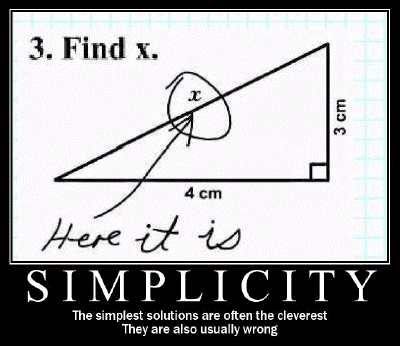
The image above can be found at http://ozguru.mu.nu/Photos/simplicity.gif

Thursday, September 4, 2008

iwantsandy.com

I think my mobile life is about to get more complicated. I have never had a Blackberry (or Crackberry as the case may be) before this job. It wasn't essential to my other positions. Now with this new job, some work travel, and managing multiple cross-functional projects with tight deadlines and heavy execution components, I will need one. So here we go...

I was a little nervous because I was trying to figure out how I'd link my personal calendar and my work calendar if I have two devices. What a pain. And now I'm beginning to see that mobile applications are going to play a big role in our lives very soon. Who wants to be beholden to any single device? I want my schedule, documents, endless numbers of lists, etc. accessible 24 hours a day, wherever I am, from any device.

My friend, Ariel, constantly teases me about the fact that many times I can't get right back to people when they leave me a message. If I take a week to return his casual phone call, I'm still hearing about it months later. Recently he joked "Christa, your social life is so active you need your own assistant." I laughed. Sure I'll get an assistant, as long as he or she works around my schedule, manages all of my life details with little effort on my part, and promises to never leave. Oh, and I'd like him or her to work for $0. "Ask and you shall receive," my mother (Sandy) always says. And that's when I met another Sandy that I think will quickly become indispensable. Real Simple Magazine introduced us. 

Sandy is a virtual assistant who emails and /or texts me any and all reminders that I set up simply by sending her an email to a special address. She has text recognition capabilities, handle calendars, to-dos, goals, contact lists. The only downside is you have to learn Sandy-eez. In order for everything to be logged correctly be Sandy - you have to speak her language and use her specific shorthand. That's not so bad though - I mean, after all, she is keeping you completely organized for free and working 24/7 with a cheerful personality.

And the only other fix I might recommend - I'd love to be able to personalize my assistant and give him or her their own unique personality and look. Maybe that's Sandy 2.0?   

Wednesday, August 27, 2008

What no one tells us about China

Last night, my friend Allan and I had dinner at Barbuto, an Italian place in the West Village that I have been meaning to try for a year. Allan is going away for 6 months - off to Singapore for work. I'm a little jealous of Allan - part of me misses flying off to a new place every week. And then I remind myself that I should be careful what I wish for.

Allan is one of my dearest friends from business school. If you had to 5 people from your life who were cheering for you, you'd want Allan there. His loyalty to his friends is something to be admired. And his work ethic would leave any American student in disbelief. He got an MBA and a half out of Darden; he put the rest of us to shame. Usually Allan and I talk about books and work ad what every crazy little projects that are taking my time these days. But last night turned to the topic of romantic relationships. Allan is confused by women. I smiled. 

Allan explained to me that in China, things are not complicated. Love included. People live a simple and diligent life. In a planned economy, there isn't all this choice that we have here in the U.S. Nothing is really all that trying. An absence of angst.

And now when I reflect back on those Olympics Games and those inspiring, creative beyond measure, ceremonies that preceded and closed them, I understand how they came to be so precise, so perfect. They were singularly focused, the entire nation. They are unencumbered by a multitude of choices and complications. 

Now, I'm not advocating for a planned economy. I'm saying that we have more to learn from the Chinese people than we ever imagined. Their creativity and their passion is built around simplicity. And the question I'm left with is I wonder if we, as Americans, could get out of our own and get focused. It might be out only hope out of so many problems that are plaguing us.  

Friday, June 20, 2008

The hard work of simplicity

I have been working on a few projects that require one simple thing: simplicity. While we crave it, work for it, buy all kinds of books and gadgets that claim to be able to make our lives simple, simplicity often alludes us. Recently, I sat with a team member to craft a memo. She kept adding, and adding, and ADDING to it. Finally I said, "Stop. Turn away from the computer. Tell me what you want to say." She could articulate her ideas well when speaking to me and the moment she sat at the computer, she hid behind an excess of words.

I found a quote later that day that gets at the very essence of good writing, and solid editing. "The ability to simplify means to eliminate the unnecessary so that the necessary may speak. ~ Hans Hofmann." And that's it in a nutshell - that is the motivation of every writer, and every editor, in one succinct sentence. To get to the diamond, you need to polish it, and that means removing the unnecessary layers.

It's easy to understand why we think simplicity should be simple. It's not - it's an art that must be practiced. It can be painful. Simplicity is work. We are complex creatures - emotions, biases, past experience, and a deep need to be understood all stand in our way. The work of an editor is to clear the path. To soothe emotions and biases, while preserving and honoring history and the ability for us to influence and affect one another.

As a quick guide, I do the following four things when I feel simplicity getting away from me:

1.) I audibly articulate the nugget of truth I am trying to convey. And then I write it down verbatim. I start from there. 

2.) I eliminate every word I can without losing the sentiment I want to convey. This can mean many different types of rework: from restructuring a sentence to finding a descriptive word that can speak for a number of smaller words.

3.) I step away from the writing, even just for a few minutes. Sometimes to get out of the hairball in our writing, we have to physically step away from it. 

4.) I only write when I am crystal clear about my motivation for writing, the channel I am writing for (print, blog, brochure, presentation, etc.), and the audience I am trying to reach. This is the framework on which we hang every word.

Wishing you simplicity and good editing, in writing and in life!

Graphic above found at http://www.simpledorm.com/images/simple.gif