Showing posts with label politics. Show all posts

Monday, January 11, 2010

Examiner.com: Interview with Sasha Abramsky, author of Inside Obama's Brain

Over the Christmas holiday I read the book Inside Obama’s Brain by Sasha Abramsky, journalist and Senior Fellow at Demos. The book is a beautifully crafted work that examines the charismatic draw of President Obama by exploring the experiences and insights from dozens of people who have worked alongside the President throughout his career. Abramsky masterfully articulates what qualities draw us to Obama, and how Obama honed those qualities in preparation for his ascent to the Presidency. The book intertwines President Obama’s personal history with his professional accomplishments in a way that makes the book impossible to put down until readers have absorbed every last word of Abramsky’s prose. I never wanted this book to end.

I had the great fortune to speak with Sasha Abramsky last week. To read the interview, click here.

Step 11: It's the Little Things

“Let's not forget that the little emotions are the great captains of our lives and we obey them without realizing it.” ~ Vincent Van Gogh


It’s easy to pay attention to the big emotions of our lives: Falling in love, grief from losing a loved one, pride for a hard-won accomplishment, or disappointment caused by betrayal. There’s no way to avoid those huge swells, positive or negative, because they take over our lives. Reading this Van Gogh quote made me think about all those tiny emotions that we feel at every moment, and that often pass by unconsciously: frustration at getting on a crowded subway car, wincing at the sting of the cold weather, gratitude when someone holds the door open for us, and joy from an encouraging message from a friend. These smaller emotions, while less significant in size, can add up to a great deal of our happiness quotient.


How do we feel about lives in the empty moments, when nothing particularly emotional is happening, when our lives are just humming along without any type of massive shift? In those quiet moments, we get a sense of our base emotions and attitude. The trick is to recognize and appreciate that empty moment. With all of the opportunities to fill up empty space, it’s easy to avoid ever having an empty moment. The empty moments are important because they allow us to take stock of the little emotions; they let us get a sense of where we are on the happiness curve.


On the way to work this morning, I was thinking about how we handle the constant tweaks of the little emotions that every day circumstances cause. Because I just interviewed Sasha Abramsky, author of Inside Obama’s Brain, I’ve been considering Obama as a role model for how to conduct our daily lives. Whenever Obama is thrown a curve ball, and isn’t quite sure how to react, he smiles. We can observe this behavior in his debates, during his press conferences, and during one-on-one media interviews.

The smile lets him pause, gather his thoughts, and remain outwardly composed in the process.


This tactic gives him the opportunity to work through his small emotions, rather than having to obey them. And he looks good all the way through the process: he looks as if nothing ever phases him and provides a thoughtful, articulate response. A wonderful example to manage the little emotions we all experience.

Sunday, January 3, 2010

Step 3: Things I Don't Know

Last night I was settling back in to my New York apartment while the wind whistled through my windows. It was so loud at one point that I couldn't sleep so I flipped on the TV to CNN. Chistiane Amanpour was reporting about Muslim radical extremists in the U.K. Though I watch the news regularly and read several newspapers, there are some topics that still confuse me. The complex network of Muslim radical extremist groups is one of them. I know all the vocabulary though I don't know how it all hangs together. And this bothers me.

I started thinking about all of the things that I know just a little about, and how much it bothers me to have holes in my knowledge. I don't like the phrase "I know enough just to be dangerous." I'd much prefer to know enough so as not be dangerous but be able to speak intelligently on a topic.

In this new year, there are a few topics that I'd really like to dig into and understand in depth. Here are a few of them:

1.) WHAT - I know little to nothing about Islam and its many factions. I'd like to take a small step toward piecing together the popular vocabulary that surrounds this religion. It's influence is growing in leaps and bounds, dominating our news waves. I should understand it more clearly if I'm to have a greater understanding of our own foreign policy.

HOW - My friend, Amy, is very well-versed in the topic so I'm going to ask her to give me a little crash course during one of our catch-ups. I'll also ask her for some primer books, blogs, and news services that would be a good reference for me.

2.) WHAT - I've been practicing yoga for a decade though have not read some of the sacred texts that serve as its base. I also don't know the Sanskrit names for all of the asanas (poses).

HOW - At the end of February I am going to begin a very intense yoga teacher training program to master this material. Every other weekend, I'll be practicing 9 hours on Saturday and 9 hours on Sunday, for 14 weeks. In addition, the program also requires meeting 3 times per week after work, independent reading and writing assignments, and class attendance at the studio once per week. It is a rigorous program that will require a great deal of focus, though my passion for the art and science of yoga will make the rigor a welcome circumstance.

3.) WHAT - The news stories I love most are those that showcase the Power of One. I'd love to read more of these stories in 2010 to understand the psychology of this personality type, and there are a few people that particularly intrigue me. There are several sources that catalog the journeys of these kind of people. Two I particularly like are NBC's Making a Difference segment and Dafna Michaelson's 50 in 52 Journey.

HOW - I've ordered a few books that share the stories of Geoffrey Canada, the Founder of Harlem Children's Zone, and William Kamkwamba, the 14 year old in Malawi who built a windmill for his family armed only with a local library book. These are incredible stories of people who saw a need in their communities and set to work to meet that need with little or no resources except their own ingenuity and passion. Could anything be more inspiring?

Saturday, October 24, 2009

My Year of Hopefulness - Teaching at Hunter College

"Good teaching is one-fourth preparation and three-fourths theater." ~ Gail Godwin, American novelist

"If you have stage fright, it never goes away. But then I wonder: is the key to that magical performance because of the fear?" ~
Stevie Nicks

Today marked my first college class teaching. My friend, Jamie, teaches an introductory political science and an elections class at Hunter College. He asked if I would come in and guest teach on the topic of social media and popular elections. With a great amount of nervousness, I accepted and went this morning at 10am to teach 2 sessions.

I have a secret - I have an awful case of stage fright. I've been known to get sick to my stomach several times before making a presentation or acting in a performance. I have a few techniques I have tried over the years and only one really seems to work: quit whining and just do it. It's amazing that once I get to the stage or the front of the room, I'm completely fine. It's the anticipation of performance that brings on the butterflies.

And so it was at Hunter. I had made copious lecture notes and rehearsed in my apartment. I was wringing my hands a bit, and worrying. Would I add any value? Would the students think what I had to say was relevant? What if I couldn't answer a question? And here's the truly terrifying one - what if there was no reaction at all from anyone? What if all I heard was crickets amid a sea of empty, expressionless faces? Ouch.

True to past experience, none of these things happened. The classes were engaged, interested, and interesting. I learned as much as they did in the course of the preparation and the class itself. Teaching is exactly like theatre with an added component of more front-loaded research, and theatre and research I know I can do. What surprised me most is how much I loved teaching a college class. Truly loved it. The time flew by, and when I was finished, I wanted to teach another session. Yes, the PhD-route is certainly the right one for me. Now I know that for sure.

In preparation for the class, I have had the great fortunate of amazing professors as clear examples. At Darden where I got my MBA, professors teach the case method. No lecturing allowed. The professor's job is to draw students out, to engage them immediately, and keep the dialogue flowing non-stop for close to two hours. This is no easy task and for two years I had the privilege to sit with masters of this teaching method like Ed Freeman, Robert Spekman, and Alex Horniman.

I have also been watching and studying Michael Sandel, a professor at Harvard who teaches a wildly popular class entitled simply "Justice". For the first time, the class is being shown on-line for free at http://www.justiceharvard.org. Every Thursday a new class is uploaded. Sandel, like my Darden professors, is a master teacher that manages to engage and facilitate discussion in a very large lecture hall. Watching him made me re-consider teaching as a profession, and reignited my interest in going back to school and getting a PhD. I must remember to send him a thank you card.

I have just created an account on slideshare.net and uploaded the presentation I gave this morning at Hunter. I build presentations as guides for a discussion and not stand-alone documents. I'm glad to walk anyone through the presentation if they're interested!

Monday, March 30, 2009

My Year of Hopefulness - The Age of the Unthinkable

In 1997, Apple launched a campaign with one simple message "Think Different". 12 years ago it was inconceivable how necessary to our survival those two words would be in 2009. Joshua Cooper Ramo, an analyst and former Foreign Editor of Time, takes this Apple campaign slogan and sprints with it, full speed ahead, to help us understand where we are and what we'll need to do to pull ourselves together. His new book, The Age of the Unthinkable: Why the New Global Order Constantly Surprises Us and What to Do About It, is a beacon for those who have been looking for straight-talk about our current economic crisis and how you and I, everyday people, can move forward.

Ramo pulls from historical examples to show how people in the midst of a situation leading to their demise never saw it coming. Gorbachev is an eloquent example. He opened up the U.S.S.R. a bit at a time, and then the momentum of change was so strong, so pronounced, that Gorbachev had no choice but to let go of the reigns he had gripped tight for so long. Is the state of our economy, and the CEOs who have long prospered under the old rules of our financial system, any different?

In this dark situation it can be hard to see any cause for hope. Ramo suggests that while this might be the darkest moment in our world's financial history, it is also the moment of greatest possibility. We have the opportunity to wipe away every preconceived notion we have about how we do business, how we live life, how we create, how we inspire, how we dream. 

"Ahead of us is the invigorating possibility of discovery and reinvention." With that simple sentence, Ramo encourages us to question every assumption about 'how it must be done'. The days of cookie-cutter policy, politics, and business are over. If we are going to craft a new, brighter future, it will take all of our courage to challenge ourselves, our families, neighbors, co-workers, and leaders. It is time to toss aside common assumptions in favor of grander, more creative, and courageous plans and actions. 

Never before has it been so possible to create a world that we want to live in. It's as if we have a blank canvas staring at us, daring us, to invent something extraordinary. The only question now is do we have the confidence to build something from nothing. Can we take up the paint brush and with wide, vibrant strokes imagine a new future and commit to bringing it to life?  

Thursday, March 5, 2009

My Year of Hopefulness - Women on the Rise

I read an amazing article this week in the New York Times about women who are finding the athlete side of their personality later in life. As recently as 30 years ago, women were discouraged from competitive sports, particularly from running. As a runner, that fact still stuns me and makes me grateful for the times when I was raised. For my mom and for millions of women like her, the road was not easy along any path, particularly when it comes to being fit and active. That is a recent phenomenon. One I am very grateful for.

The article left me thinking about what other areas of life have been off-limits to women that are now seeing the tide turn. Certainly in women being entrepreneurs and controlling their own careers. Great strides have been made in media - there are so many to name in that field. From Oprah to Barbara Walters, Katie Couric, Christiane Amanpour, Arianna Huffington. And the list goes on. I am always proud of how many female business journalists have been featured as our media chronicles this latest economic downturn. I often think that women are running the reporting from Wall Street: Maria Bartiromo and Erin Burnett are terrific examples.


I am now reading a book entitled Another Day in the Frontal Lobe. It's the story of Katrina Firlik, a young neurosurgeon. She was the first woman accepted into the neurosurgery residency at the University of Pittsburgh Medical Center. Certainly in healthcare, and particularly in fields like neurosurgery, women like Dr. Firlik are paving the way.


Technology is seeing its fair share of women on the scene. Ning co-founder
Gina Bianchini, Yahoo! CEO Carol Bartz, and Charlene Li who authored the book Groundswell while at Forrester Research, immediately spring to mind. Having made great strides in this industry, women have a long road ahead. Fast Company recently ran a feature on some of the most influential women in tech. It's a good read and I highly recommend it.

In politics we are lucky to have so many women taking the helm. I am very proud that Secretary of State Clinton heeded the calls during this difficult time that America's reputation is facing around the world. I cannot imagine anyone better suited for the job. Ruth Bader Ginsburg, Shirley Franklin, and Janet Napolitano are other shining examples of the many that serve in all levels of government.


I consider fields like energy, transportation, and engineering and wonder how women will make their marks in those areas in the coming years. It will be exciting to watch and to take part in that development. With so many incredible female role models to learn from, women are poised for take-off.

The photo above was taken by Filip Kwiatkowski for The New York Times.

Tuesday, January 20, 2009

My Year of Hopefulness - The Gift of Obama

There are many articles that will be written today regarding the inauguration of Barack Obama. January 20, 2009 will be referenced for decades to come as the day that the US turned the corner and found light in all the darkness. It was the day when we all came together to lift the heavy burden of the dismal economy, multiple wars, a crumbling environment, a healthcare system in tatters, and an education system that needs serious attention. It will be known as the day that we began to rise up and over obstacles that for so long have shackled us to bad policies and petty grievances. It will be remembered as the day when our inspiration and creativity was alighted again and never to be put out. A miracle of hope and faith and belief that we can and we will lift ourselves out of the muck, and reach down to help others out, too.  

I will remember it as a day when my confidence soared because I watched a man who believed in himself and in all of us so that he could overcome centuries, literally centuries, of deep discrimination, prejudice, and injustice. The son of an African immigrant, a continent largely forgotten by our foreign policies, received a top-flight education and ascended to our country's highest office and honor. And he did this with the small contributions of help and time and dedication by hundreds of millions of common people just trying to get by. He rallied us to make us believe that each of our individual voices could and should and would make a difference if we could all get going in the same direction. He won the Presidency by winning our hearts and our minds and our spirits.

Today we received a great gift - a talented, trustworthy, empathic leader whom we can look to for guidance and support. He believes in us as much as we believe in him. And it's with that mutual respect that we will be able to turn our country around, eventually. Lend your voice at http://www.whitehouse.gov

Monday, January 19, 2009

A Perfect Union

Can you feel the excitement and anticipation and trembling from joy in America and around the world? Everywhere you look, no matter who you speak to, there is this wonderful sense of hope. I am watching scenes from Washington D.C. on the news and so wishing that I was there with everyone to share in this moment. Thank goodness for television and the Internet that will let us bear witness no matter where we are tomorrow.

We are in the last hours of the Bush administration. Tomorrow night at this time he will be back in Texas, his long eight years as our President having come to an end. My mother has a saying that I have had to repeat to myself almost daily for 8 years, "This too shall pass." She's right - it did. It was arduous and painful, but it did pass. I would feel a bit bad for the man if he hadn't so completely decimated our country and left it in such a state to hand over to Barack Obama. Now I am just grateful to finally big him farewell. 

Four years ago, I was living in Washington, D.C., working for an environmental nonprofit. I was crying on that inauguration day. I had just finished reading "Dreams of My Father" and tried very hard to convince myself that Barack Obama was elected not as a Senator from Illinois but as our President. Four years later, it is an awesome thing to realize that that wish has been answered. 

Last night, NBC replayed the SNL Presidential Bash episode. In all of the excitement about Obama's election, I had forgotten what a long-shot he was for most of the past two years. He an unlikely choice - inexperienced, too young, not accomplished enough. Now he is about to become the most popular President in history because he gave a voice to people who had been silenced for so long - the young, the disgruntled, minorities, middle and lower-middle class, the poor, and those who never had any kind of interest in politics or candidates. He not only got them to listen, he got them to rally. He got them to all go in one direction. And all the while, "experts" and "insiders" doubt him publicly. He believed and he made us believe. And he got us to not only believe in him, but more importantly to believe in us. 

If there is one lesson that his election has taught us it is the incredible belief that possibility is only limited by leadership and empathy. In my early career I was trained that hope was useless - only hard work ever got anyone anywhere. Barack Obama changed that for me - he showed me that hope is a powerful motivator, a powerful tool that can help someone create something from nothing. He awakened in me a new sense of commitment and creativity and conviction. He made me feel lucky and proud to live in these times. 

Congressman John Lewis gave a very powerful interview with Brian Williams tonight. Congressman Lewis describes his feelings about the Obama inauguration and what it means to him having marched on Wachington with Dr. Martin Luther King. 6 minutes long, elegant, and emotional. And his quote that most stands out to me is, "To see this event, this achievement, it was all worth it."

Saturday, January 10, 2009

My Year of Hopefulness - A Thousand Splendid Suns

It has been a long time since I've found a book that is so powerful, so compelling that it makes me stay up until 4am to finish it. That's exactly what happened with A Thousand Splendid Suns. As a writer, I find I learn much more from reading than I could ever learn in a class. Khaled Hosseini weaves a beautiful, heart-breaking, heroic tale about life in Afghanistan. It was hard for me to imagine how he could ever write a follow-up as emotional as The Kite Runner. He did it - A Thousand Splendid Suns is a perfect novel. 

As a woman, it was especially moving to read the story. It made me realize how very lucky I am to be an American, to be educated, to be free. I spend each of my days living the life I want to live. Not all women, particularly those in Afghanistan, as as lucky. And it is luck that separates us, me and the women of Afghanistan. Otherwise we are the same - with dreams and aspirations and opinions and beliefs. A Thousand Splendid Suns made me grateful, and t made me feel like I owe it women everywhere to live a life of my own choosing. Freedom is a gift that should not be wasted. 

I love novels because they take us out of our own environment. They force us to live a different life, by different rules, with different choices and consequences. They transport us. There is one scene in the book where a women is being led to her execution in order to protect a friend. At first, I tried to reason every way she could get out of the situation - how she be free and still protect her friend. At first blush, I was horrified at the character's choice, and then as I lived with her memories, with her circumstances, I began to see that I would make the same choice she did. I understood. I empathized. 

I don't know of a social tool more powerful than story. Hosseini is a master of weaving fictional characters into history, allowing them to share the emotional and human fall out caused by societal actions. He makes a strong case for justice and truth and reason and hope - the very things our world needs more of. 

Friday, November 28, 2008

Thankful

Now that the food and travel of Thanksgiving have passed, I'm spending the morning eating leftover pie, drinking coffee, leafing through retail sales circulars, and considering all the things I am thankful for. Friends and family go without saying. This has been quite a year to date so items are making the list that have rarely if ever been on the list before:

My job - despite the normal frustrations that come with every job, I am especially grateful for my current position because the day-to-day tasks and the big picture view get me up out of bed every morning. I'm learning this is a rare blessing.

A place to call home - my friend, Monika among many other people close to me, are quite shocked that I have lived at one physical address for longer than a year. That hasn't happened since 1998. Ten years of moving at least once a year. Good grief. And now I am finally in a city that is comfortable and feels like home. I feel a sense of ownership and belonging that I haven't found before in my life. The stability of that sends waves of peace into my life that I have not had before.

Interesting times at a young age - the economy, politics, social activism. We are living in unprecedented conditions and if we can push aside the sense of uncertainty that invades our lives regularly, it is truly a spectacular opportunity for learning. To have this privilege so early on in my life and career is a tremendous gift that will inform many decisions I will make in the year to come.

The opportunity that lies ahead - we may look out into the world at the moment and see a very bleak picture. Though hidden within the folds of that bleak cover, there are wrinkles and pockets of opportunity. Going forward, there will be incentives for us to start businesses, to become a society of savers rather than spenders, to take up the call to protect the environment, and to build better transportation systems in our cities that will benefit generations to come. The good times will roll again, though in different, and dare I say better, forms that before.

In business school, Frank Warnock was one of my economics professors. Frank developed his expertise in international capital flows as a Senior Economist in the International Finance Division at the Board of Governors of the Federal Reserve System in Washington, DC. And whenever we reviewed cases or economic situations that were troubling, he would always say, "You have to be hopeful. What's the alternative?" Those words ring truer today than ever before. And for hope, and the people who remind me of its value, I am most thankful.

Sunday, November 16, 2008

John Adams

I don't have HBO and missed out on the showing of John Adams. I read parts of the book by David McCullough when I was in business school. I took a class, on the Lawn, about Thomas Jefferson. Being a great Jefferson friend, then adversary, then friend again, John Adams had to be included. 

The HBO film and book bring to light the frightening prospect that Americans faced upon declaring their independence. We take this for granted today -- of course we are free and independent. The film drives home a visual image of the frightening times that led up to, through, and after the Revolution. They took a "leap in the dark" as Adams said to Jefferson. You get a feeling for the contentious, volatile, and passionate personalities. And it's a good education in politics and negotiation. 

Ben Franklin had two quotes in the second part that effected me so much that I paused the DVD to write them down: "Politics is the art of the possible" and "Diplomacy is seduction in another guise. One improves with practice." I think about these two quotes in light of our recent elections. How President Obama focused on the possible - how he ignited people's sense of hope with that idea - and how elegantly and patiently he played out his hand. He was the unlikeliest of candidates, by his own admission. There must have been times that he was uncertain, even scared or nervous. I imagine there must have been times when he would step back, breathe, and take another step forward. I am envy this kind of patience, and I am working on it as an area of development.

In John Adams, we see that Adams had no patience. H wanted to act swiftly and without hesitation. And he nearly missed the very allies he was looking for, even though they were standing right in front of him - the gentlemen from Virginia: Washington and Jefferson, one who would lead the battle by sword and the other by his pen. They also had this reverence for patience and humility. They had the same goals as Adams - an independent republic and governance by the people; they just went about achieving them in different ways.

The movie also makes it clear that each player has his part and I was left wondering if we'd have this nation today at all if any of those personalities had not been present. It made me re-consider the frustrations I have sometimes felt on group projects and it gave me greater perspective and appreciation for people I have sometimes terms "difficult". Maybe we all need a John Adams in our lives to help us to value and take decisive actions when the opportunities arise. And maybe we also need a Franklin, Washington, and Jefferson to teach us the value of diplomacy in getting what we want and to help us believe in the art of the possible. Most of all the film makes the case for a group of close advisers, no matter what path we take in life.       

Sunday, November 9, 2008

A time for geniuses

Traditionally, grade A educations have been more prevalent in elite, affluent circles. But the tide may be turning on that trend - Obama could do for high-quality education what Target did for design. He could make it desired by, and possible for, all.

This past week I had lunch one day with a group of people I don't know well. We were discussing the election and one of my lunch companions said, "Who would ever want to be President at a time like this?" This morning, I was watching Meet the Press. Doris Kearns Goodwin, Presidential historian and author of Team of Rivals, quoted Abigail Adams when asked about how Obama will govern with all of the problems he is facing. "These are times that a genius wants to live." If only I had access to that quote during my lunch. 

And the same could be said of anyone who runs any kind of team, any kind of company. The challenge, the fun is rolling up our sleeves when things are messy and in disarray and setting them straight again. It's in the churn that we find our new direction. Abigail Adams was right -- this is a time that a genius wants to live. And I would add, it is also a time when a genius wants to lead. Thank goodness we had the sense and foresight to elect one.      

Wednesday, November 5, 2008

The value of and quest for alignment

I walked around all day today with a smile from ear to ear because this morning I woke up more hopeful about our future than ever before. The afterglow of the election was shining brightly on people's faces everywhere I went - at work, on the subway, in the grocery store. Construction workers at ground zero, my co-workers, doormen of apartment buildings in my neighborhood. I'm getting emails from friends telling me how excited they are about our future. And that excitement is infectious. Obama will be the greatest President this nation has ever had. I believe. As Thomas Friedman said in his column today, "The Civil War is over. Let Reconstruction begin."

The critical activity that lies before Obama, and us, now is one of alignment. I thought a lot about the difficulty of achieving this state, especially among parties, factions, and classes that are sometimes so disparate with competing interests and values. I'm working on a project at work that is nearly at completion and just when I think I have alignment, something threatens to derail us and I have to gently and firmly coax that detail back into line. It is amazing how much daily effort and time alignment costs; it is an endless pursuit. 

So how will Obama get to alignment and how will we help him get us there? I've found that focusing on the finish line and getting others to place their focus there is most helpful. Playing pool helps.

An old boyfriend of mine was a very good pool player, and he taught me how to play. When I first met him, I wasn't very good. I always focused on my cue ball, not on the ball I was trying to hit. And without fail, I would miss my shot. What I needed to do was get my eyes in line with exactly where I needed to hit that prized ball to sink it, not on the ball right in front of me that I would hit with my cue stick. I needed to keep my eye on the prize in the distance- that ball that I couldn't quite get to directly. My game dramatically improved. 

The same strategy that works for pool can work for alignment. Get everyone looking toward the same goal, the same prize. And then you will find that they are less concerned that their desired road must be taken to reach that destination. As the leader, you choose the road that's leading the group to the common goal, and cast the players according to their strengths and curiosities. Alignment is possible, even in the most fragmented of circumstances, if we as leaders are committed to making that alignment priority number one, every day.     

The image above can be found at http://static-p4.fotolia.com/jpg/00/06/11/21/400_F_6112144_t94UJu9HPCAKP3oR0IyxXWddBYWXkdwU.jpg  

Tuesday, November 4, 2008

O-ba-ma

"O-ba-ma". That is the chant that is echoing down the streets of my neighborhood. People throwing back their heads in laughter. Cars beeping their horns in celebration. There is joy in the air. 

We have a long road ahead to rebuild this nation, to heal this world that has been plunged so deeply into despair. And while hope is not a strategy, it is certainly a tool, something that will build us up, something that will give us confidence to keep going, in spite of the tough times that lie ahead.

We banded together. And we did it. We stood up, we let our voices be heard, and we count.   

Tuesday, September 30, 2008

Worried about the economy? Here are some quick answers to common questions

I was going to post about myself, my life, and my observations about the world around me today. However, I'm hearing so many people say that they don't understand how this current economic crisis is going to hit them personally, that I wanted to do my part to try to get the word out about 4 common questions that many people have asked me over the past few weeks:

1.) "Do I need to pull my money out of my savings and checking accounts and put it in my mattress?"

No. Please don't do that. If it gets stolen or you have some disaster like a house fire, you'll lose it all. Also, as long as your money is in a bank that is FDIC-insured, your money is safe up to $100,000. If you have more than $100,000 with the same bank, then take out the balance above $100,000 and move it to an entirely different bank, not just into another account at the same bank. The $100,000 insurance is per depositor, not per account! Don't know if your bank is FDIC-insured? Call them, stop into a branch, or visit their website.

2.) "I think I am going to stop investing in my retirement fund because the market is so bad. Is that a good idea."

No. No, no, no, no! Please don't do this. Please. Economies go in cycles. You need the compounding on your retirement savings to make retirement plans work. If you pull out your money or stop investing, you will lose the compounding factor you need. And you'll pay hefty penalties on the withdrawal plus lock in the loss. What you can and absolutely need to do is make sure that your portfolio is balanced. Many retirement plans have a "set it and forget" plan. That's what I have. You plug in the number of years you have until retirement, and the plan automatically calibrates different investments to get you to your retirement goals. Still unsure? Make an appointment with an advisor at the institution that manages your retirement accounts - it's free and it's their job to explain your options to you. And if you don't know how to make an appointment with them, contact your HR department. 

3.) "This job market is so crazy that I've decided to get out of the job market. Is that a good idea?" 

AH!!!!!!!!!! No - no no no. Don't do that. If you retire now, you essentially lock in all the loses your retirement fund has just been hit with because you begin to draw on those funds yo worked so hard to save. This is bad - really, really bad. You worked hard all these years, and you're not getting the full benefit of that hard work. If you're quitting your job with nothing else to go to, you need to reconsider immediately. And change your mind - do no leave your job without another place to go. There will likely be nothing for you to go to. Now, I do think you should be networking and watching out for new employment opportunities that sound interesting. Actually, I think you should ALWAYS do this, even if you are 100% in love with your job. You need to cover your bases and in this day and age, getting a job interview (and probably getting your dream job or even just your next job) has much more to do with who you know rather than what you know.   

4.) "I don't think Wall Street zillionaires should get a bailout so I'm against the Government's $700 billion plan."

I don't blame you for being confused on the bailout - I blame politicians who don't understand economics (inexcusable) and make this a partisan issue (also inexcusable). This is not about bailing out Wall Street. I'm really upset with the person who coined this plan as a "bailout" - it's not. This money will make the Federal Government a bank that will loan money to banks like Citi or Bank of America to make it easier for those banks to responsibly loan money to average consumers (you and me). There will be plenty of Government oversight to make sure that money is loaned responsibly. And when the market recovers, those banks will pay back the Government, who will pay back the tax payers.   

If we don't have this plan, here's what will happen:
Access to credit will plummet, making it hard for all Americans and all American businesses to have any access to credit. All free markets need access to credit to function properly. This los of access to credit is not good - you won't be able to get car loans, schools loans, mortgages, or any other kind of consumer loan. Credit card companies will cut your limit. All businesses, whether it's your local pizzeria or GE, will not be able to get the loans, short-term and long-term, big and small, that they have to have to do business and to get us the goods and services we need to survive. Bankruptcies and home foreclosures will skyrocket, and as a result, unemployment will also skyrocket. We'll be in a downward spiral.

So here's the choice: a) pay some more taxes now and get that money back in the fairly near-future so our economy can get going again. b) pay a whole lot more now with people losing their homes and companies going out of business, causing unemployment to rise rapidly, and pay even more later as we struggle to deal with the fall out. And we will ALL deal with the fall-out, especially those in lower and middle income brackets. The recovery from option b) will be slow and painful. a) will be less painful and shorter. I'm going with a). I don't like that we're in this situation, but here we are.

This might be the only idea that George Bush and I will agree on, and I took some convincing. I read A LOT about this, talked and listened to a lot of people very knowledgeable in finance. At this late date, the horse is out of the economic barn and the only way to corral him back inside and under control is through a rescue plan. There simply is no other better option.  

Monday, September 29, 2008

The agony of confusion and the ecstasy of clarity

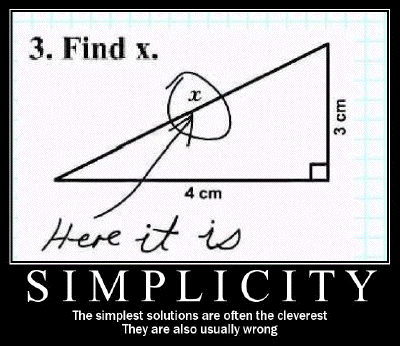
By nature, I'm a passionate person. There are a few subjects that really get me going - happiness, creativity, health and wellness, the environment, puppies. (Not necessarily in that order.) And simplicity - I'm big on that. If we all worked on making our world and our lives simpler, we would all be better off. In some circles complexity and confusion are celebrated, relished, even chased because it's a mark that what those people in those circles are doing is "very important" if no one else can understand it. How ridiculous, not to mention wasteful - something we can no longer afford to be in our economic situation. 

I was shocked to hear the news today that the House didn't pass the "bailout". The Dow tumbled along with stock prices of major companies, and panic is spreading, slowly and quietly. It's unsettling. Someone said to me today that she didn't really ever understand the plan, and it's too bad that it was never explained thoroughly and clearly to the American people. I almost see her point - I do think it was explained by major media outlets like Business Week and the New York Times. You just needed to have the patience to wade through the lengthy articles. And if you don't understand something, ask around and get some help. Don't just throw up your hands and say "forget it." What really happened in the coverage is that no one made it simple to understand if you didn't have a degree in economics or an MBA. 

Simplicity and clarity are absent in many areas of our lives: in meetings at work, in relationships, in the many contracts with very small print that govern our well-being, financially and health-wise. Companies spend a lot of time, effort, and money because of confusion in roles and responsibilities, objectives, and priorities. Simplicity saves a lot of heartache. And we get to simplicity by being real, honest, and straight-forward in our intentions and actions. 

Clarity builds trust and integrity; it makes people feel that they are a part of an effort because they understand it and can clearly articulate it. Being clear and concise is a sign of maturity - it's the responsible thing to do regardless of circumstance. Confusion never pays in the long-run and only delays the inevitable. If only our government and financial markets understood that - maybe we'd find ourselves and our economy in much better shape. 

The image above can be found at http://ozguru.mu.nu/Photos/simplicity.gif

Tuesday, September 16, 2008

Moving to Higher Ground: How Jazz Can Change Your Life

I gave up my horn about 10 years ago because truth be told I wasn't even mediocre, and even if I practiced for hours a day I'd never be great. I want to be a lot things, but I have no intention of getting in the habit of spending my time being mediocre. I love jazz, but I couldn't play it. I just don't have that ability. My creativity is in my writing. 


So for years now I have socked away all of the academic knowledge I built up around the music. (I studied it for a year in college and played in a few different bands.) People ask me if I miss playing, and truth be told I don't. I never even think about it. Playing music doesn't hold any kind of magic for me, but I still very much enjoy listening to it, and really what I enjoy is the history, all of the stories that come along with musicians. And there are plenty of stories to go around. 


My brother is a trumpet player and because he is 6 years older than me, I learned about Wynton Marsalis and the Marsalis family at a very young age. When I saw that Wynton would be at my local Barnes and Noble I decided to go hear some of his stories. He was so engaging and charming that I bought his book on sight, which I never do at author readings. And once I started reading Moving to High Ground: How Jazz Can Change Your Life, I couldn't put it down. (And it helps that his co-author is the brilliant and well-spoken historian, Geoffrey Ward.)


For me the genius of this book is not to tell you about all the drugs that musicians have done, or all the women they've had or how down and out and poor they were. It talks about what the music has to teach us about living other aspects of our lives. How we treat each other. It teaches us about acceptance and nurturing and compassion. Wynton lays out the value is studying jazz not to be great, but to realize a certain aspect of humanity that comes through generosity.  Its is a living, breathing thing that connects the generations. It allows us to learn from generations of people who were long gone before we were every a twinkle in our parents' eyes.  


Wynton goes on to talk about how we all hear something different in the music. He talks about arrogance and greed and the darker sides of our personalities that the music uncovers. But mostly he talks about how musicians with disparate styles can come together, should come together, to create something wholly different than they could ever make on their own. Nobody gets through this world alone in the same way that no jazz musician builds a career alone. Jazz is a way of capturing what it means to be out and about in this world. It's a way of sharing that experience with others whom we will never meet but for whom our music could be a beacon of freedom if we are strong enough to tell our own stories, look them in the eye, and harvest the very best of what they have to teach us.


Wynton's thoughts on community come at a particularly poignant time. Throughout the book I thought a lot of about the state of our world. How scary all these moving parts are - the economy, our national security, our political systems, health care, education. There is a lot to be afraid, maybe even more to be afraid of than at any other time in our history. What jazz, and musicians like Wynton teach us, is that the only way we can be safe is to let go of that fear with the confidence that those around us will support us. Their harmonies will carry us through. And if all else fails at least the swingin' will give us enough encouragement to keep our chins up and the rest of us moving forward with grace.  

Monday, September 8, 2008

One Thing We Don't Want to Change

Thomas Friedman wrote a brilliant article in the Times last week about innovation in the U.S. At the moment, we are the most innovative country in the world, though that is changing. Quickly. And though there are a lot of people in the press these days talking about change, few are talking about innovation, much less the need to foster that effort in our people. And it needs to be addressed, head on. Now. 

We are spending a lot of time talking about how to save manufacturing. The trouble is we can't save manufacturing if we don't save the innovative processes that dictate what to manufacture. And we can't save the innovative process and its wonderful outcomes without seriously addressing education - and that includes K-12, college, and graduate school, the latter of which is nearly becoming a non-negotiable credential for those who want a modicum of job and financial security. In the case of K-12 education, the improvement child health and well-being is critical. And without K-12 education, we don't have a prayer. 

Despite the fact that I have been a fan of Barack Obama since his entry into politics, I voted for Hilary Clinton in the primary. Many people ask me why when she seems so divisive and polarizing. One simple reason - I believed she would fix healthcare, which leads to better K-12 education which fosters innovation that supports our economy and global competitive advantage. Healthcare is a root cause to so many other problems we have in the U.S., and around the world. And if were going to talk about priorities and what to focus on first in this next Presidency, my wish would be that we make good health for every American a non-negotiable goal.       

Thursday, August 28, 2008

What Obama means to me

I am one of those people that Barack Obama talks about all the time - I am frustrated and disheartened by politics. I feel let down by our government and its officials. I've long thought that there is nothing that any politician can do that would get me to believe again in our government. For me, business has been the answer. A free market economy can do much more for peace and prosperity than any government. Until now. 

Usually I don't write about politics on this blog, though I think by my expressed beliefs and opinions it is obvious that I am a liberal. Until this year, I have never belonged to a political party and I have never made a political donation. After 8 years of watching us go down the wrong path in every area: education, healthcare, foreign relations, the economy, the environment, I couldn't be an "NE" anymore and there's no way I could ever be a Republican. 

So I became a Democrat and I voted for Hilary Clinton in support of a woman whom I very much believed would fix healthcare, an issue that I have grown increasingly passionate about since my mom was diagnosed with breast cancer nearly two years ago thanks to advanced technology that found the smallest of tumors and treated it effectively. 

I have always liked Barack Obama; I have read his books, and now that he is the nominee, I support his efforts whole-heartedly, with my money, with my writing, and with my time. After hearing his speeches, I cannot help but feel hopeful, and it has been so long since I felt that sense of hope in our government that I barely recognized it when it hit me.  

I believe that he is like the greatest of stage directors - honest, passionate, and unifying. He listens and speaks with conviction, not stating opinion as fact but making his case to bring seemingly disparate parties together. He's decent and fair to the point that he softened the sharp edge I develop every time I hear the word "politics". He makes me feel like we can and will be safe in this uncertain world. I feel his energy through the TV and in the people who support them. He may be our first President in a very long time who gets that leadership is about service, not ego. 

He has already moved mountains by motivating millions of people like me around the world to get interested again in our government and the people who run it. And if he can do that, imagine what he'll be able to do as our Commander in Chief? To me, he is a rock star in every good sense of that word. He makes me proud and optimistic, and in this day and age that is exactly what we all need. 

Saturday, July 19, 2008

10 little things

My friend, Julie, is in Tanzania for about 2 months. She's on assignment with the Peace Corp and has started a blog to track her experiences. http://turnyourhead.wordpress.com/

On one of her posts, she takes a cue from her blogging sister and lists 10 little known things about her that are interesting and unique. I love the idea so much that I'm stealing it. Thanks for the inspiration, Jules :)

1.) The first profession I ever had an interest in was paleontology because I loved dinosaurs.
2.) When I was little, I memorized every fact about Africa that I could get my hands on and my mother would patiently listen to me go on for hours - if only we had the internet then.
3.) I was a Girl Scout until I was 12.
4.) I learned how to swim when I was 30.
5.) This is the first year I have ever been registered with a political party. My mother gave me a voter registration form when I turned 18 and until this year have always been an Independent.
6.) There is a tractor crossing sign on the road I grew up on. 
7.) The two countries I must visit some time in my life are Rwanda, to see the mountain gorillas, and Cuba because of the movie For Love or Country.
8.) I hate talking on the phone - it's my least favorite form of communication
9.) My favorite charitable cause is environmental protection
10.) Mary Lou Retton was my childhood idol  
and a bonus fact:
11.) My sister and I have two common obsessions: The Gilmore Girls (my baby niece is named after Lorelei Gilmore!) and Dunkin' Donuts (which we affectionately refer to as "Dunks")