Last year I wrote a few posts about Randy Pausch's Last Lecture. I first watched him give the Last Lecture on YouTube through tear-filled eyes and had to take myself for a long walk 3 months later when I read about his passing. His Last Lecture, devoted entirely to his pursuit of childhood dreams, reminded me of how important our earliest dreams are and how they shape us in adulthood. Randy Pausch reconfirmed my belief that childhood dreams, those daring, bold expressions of our deepest desire before we ever realize we have limitations, are some of the most valuable things we own. We should celebrate them and go for them with gusto, no matter what our age is.Friday, December 25, 2009
My Year of Hopefulness - Thanks for Making My Childhood Dream Come True
Last year I wrote a few posts about Randy Pausch's Last Lecture. I first watched him give the Last Lecture on YouTube through tear-filled eyes and had to take myself for a long walk 3 months later when I read about his passing. His Last Lecture, devoted entirely to his pursuit of childhood dreams, reminded me of how important our earliest dreams are and how they shape us in adulthood. Randy Pausch reconfirmed my belief that childhood dreams, those daring, bold expressions of our deepest desire before we ever realize we have limitations, are some of the most valuable things we own. We should celebrate them and go for them with gusto, no matter what our age is.Friday, October 16, 2009
My Year of Hopefulness - Where the Wild Things Are (and Were)
"One does not discover new lands without consenting to lose sight of the shore for a very long time." ~ Andre Gide, Nobel laureate in literatureMy sister, Weez, and her family are visiting me for a week. My brother-in-law, Kyle, is a painter and given the cold weather we're having in New York City, this vacation is all about museums. For several weeks, he's been scouting cultural websites to see what exhibits are currently open. One of the exhibits that caught his interest is at the Morgan Library, and includes original sketches, watercolors, and book notes from Where the Wild Things Are by Maurice Sendak. Being avid fans of children's literature, we stopped in there today to have a look.
I have loved Where the Wild Things Are since I was little. I loved it because of its use of theatre and imagination. Max and his make-believe adventures made me believe that I could travel to distant and strange lands, too. Now as a writer, visiting this exhibit brought a whole new back story to the book. Originally the story was about wild horses, not the Wild Things we have come to know and love. Sendak abandoned the project for many years before completing it. During his first attempt he wrote that the story felt forced so he had to put it aside for now. He kept returning to it again and again to see if the story might flow more easily on another attempt. Eventually, he found an open door. My favorite margin note is "focus on Max." Despite his mastery of storytelling, he had to deal with all of the same anxieties so many other writers deal with: not knowing what comes next, starting a story, dropping it, and picking it back up again at a more suitable time, and the feeling that his focus was sometimes a bit off.
As much as I love Sendak's writing, his thoughts on his writing were even more interesting to me. The exhibit reaffirmed for me that writing is a physical workout in many respects. It's something that must be practiced consistently, even when the writing doesn't come easily. There will be periods of frustration when the words just don't flow the way we'd like them to and that's okay. Focus and commitment is something we must continually strive for, and some times we will need to write ourselves a prescription for them, a reminder of what's really important. And that's okay, too.
It's so easy to think that genius in any form belongs to the few, the gifted. Realizing that people whom I admire so much, such as Sendak, are just ordinary people like me reminds me that there is a little genius in all of us. Within everyone's imaginations, there is a brilliant story, our own Where the Wild Things Are, that is brewing. The land of the Wild Things is always right here beside us. To get it down, we just need to commit to showing up at our computers or at our notebooks with a wide open heart, a good set of ears, and an abundance of patience and determination in equal amounts.
The image above is an illustration by Sendak from Where the Wild Things Are
Sunday, October 4, 2009
My Year of Hopefulness - The Life We Receive Without Asking
"Our plans are nothing compared to what the world so willingly gives us." ~ Margaret Wheatley
"Never tell everything at once." ~ Ken Venturi, American former professional golfer
On Saturday evening, I headed across Central Park toward the Metropolitan Museum of Art. As I crossed the park, I passed between the southern border of the Great Lawn and Belvedere Castle. It's one of my favorite little pieces of New York City. There's some sort of happy air that exists in that little triangle; it's impossible to resist smiling there. I always feel romance and unending possibility as I traverse that ground. It was late afternoon so the sun was just streaming over Belvedere, the clover and honeysuckle filled the air with a perfume that I wish could be bottled, and there was a soft breeze. For those few moments, everything felt perfect.
On Friday and Saturday nights the Met is open until 9:00pm so I wanted to take advantage of the extended hours. I checked in on my friends Vermeer and Rodin, stopped by to visit the empires of Northern Mesopotamia, and spent some time among the folk artists of Oceania. It's almost inconceivable how lucky we are to be able to walk among so many priceless pieces of art at a moment's notice.
At the Met I was on a little bit of a mission. I've been working on some children's fiction over the last few weeks. Every day that I sit with my characters, they tell me something new about themselves. In a way, creating characters is like getting to know a new friend. I uncover little pieces about them over time, just by sitting with them and letting them tell me their story. Every day I'm reminded of Julia Cameron's book The Artist's Way, when she says "Art is not about thinking something up. It is the opposite -- getting something down." While I have a general map for the story, the characters themselves are just letting me tag along on their journey. The characters themselves will provide a far richer, more intriguing story than I could ever plan. That's the great joy and magic of writing.
As I was wondering through the Greek and Roman Galleries, the art of Cyprus, and the rooms full of knights in shining armor, a lot of ideas were drifting in and out of my mind. I dutifully wrote them all down - bits of dialogue and thoughts and twists and turns in the plot. After recording them all, I stopped to wonder if they made sense. And then I realized the characters I'm writing about can actually do anything they want. Writing fiction is a little daunting for this very reason - all of a sudden the possibilities are wide-open. When you're just getting something down, there are no more limitations. Writing fiction may present our one and only opportunity for complete and total freedom.
While I went through Central Park and to the Met to accomplish something specific, I found something far greater in both places than I had intended. These experiences reminded me that the world has great plans for us, far greater plans that we have for ourselves. And while not having control may at first seem frightening, in many ways it's as freeing as writing fiction. Unexpected, incredible circumstances, people, places, and opportunities are going to appear in our lives through no effort of our own. All we need to do to receive them is to show up with an open heart, an accepting mind, and the willingness to listen. If we can do this, the magic that is all around us becomes an unlimited and constant presence in our lives.
Sunday, August 23, 2009
My Year of Hopefulness - Writing Peace
Forester, A Room with a View Yesterday I read a post on Theatre Folk that talks about how the physical place where a writer is located effects the quality of the writing. So often, we think writing is some elusive, muse-like magic that just shows up when it's good and ready. I'm still waiting for my muse to walk through the door, so I figured that while I'm waiting I should follow the advice of E.M. Forester and hang out in the sunshine.
Right now as I'm writing this post, sunshine is streaming through my living room window, dappling the keyboard. My apartment faces into the courtyard (which sounds lavish, but I can assure you it's not) so I can see the goings on of all my neighbors if they're at their windows. This also means I avoid a great majority of the street noise, though because I'm on a higher floor, I also get the sunlight. It's a win-win for me and my writing. There are some trees and butterflies outside right now. The blue sky is swirled with clouds and the breeze in gently blowing. It's a peaceful kind of place.
By my desk I keep three things taped to the wall. One is a card with the quote from Thomas Jefferson, "The most valuable of all talents is that of never using two words when one will do." The art of brevity and good editing. The second is a card that has my 2009 to-do list. I wrote it up in December of 2008 and so far, I'm doing pretty well. I'm actually on track to complete all 10 by the end of the year. They are things I am really interested in, and just needed to dedicate the time to them. For example, I wanted to cook more, get a new apartment, and expand the reach of my writing. Done, done, and done. The third thing is a card with a simple quote by John F. Kennedy: "Peace is a daily, a weekly, a monthly process."
I used to think that peace was a destination. An achievement. Since I was a teenager, I made one simple wish on birthdays, when I'd see the first star at night, whenever I'd blow an eyelash from my fingertip. I just wanted to feel at peace. Sounds like such an easy thing to have. Just stop worrying and feeling anxious and scared and stressed, right? Right. And all of that was very hard for me. Much harder than I wanted it to be so in addition to feeling all of these things I also felt frustrated. Where was that damn peace of mind hiding?
Now I know that peace wasn't hiding at all. In order to access it, I had to go out into the world and live. Peace doesn't have a permanent place at all. It's an active, living, breathing way of life that moves with us, within us. It's accessible at any and every moment. And just because we feel it at this moment, doesn't mean it will be readily apparent the next. It is a state of mind that we must continually commit to, and share with others. And eventually, it just becomes a part of us. We will, with time, patience, and practice, be a living vessel for peace, and I hope my writing takes on that form as well. Though to tell you the truth, sunshine on my keyboard certainly helps.
The photo above is the view from my desk in my living room, where I do most of my writing. If you look closely you can see my reflection in the bottom left corner, snapping the photo.
Wednesday, June 17, 2009
My Year of Hopefulness - Our Defining Value
My friend, Jamie, sent this quote to me today. His professor, Andy Gelman, posted it on his blog. It got me thinking about how this applies not only to professions, but to our lives in general and who we are, what we stand for. Many people are defined by their jobs. One side effect of this tough economy is that many people who have lost their jobs (and in some cases lost their entire industry) are being forced to reconsider who they are when their jobs are peeled away.
When I was a kid, I loved Mr. Rogers. My favorite part of the show was the very beginning when he would come into his house, take off his dress shoes, and put on his sneakers - signaling that he had left the outside world and his job behind. The fun was about to begin the moment he put on his sneakers.
I live this kind of life, too. The moment I leave my office and hop onto the subway to zip home, I take off my work title and become a writer - exactly what I am at my core. I write almost every day and collect quotes, magazine articles, books, and experiences that all get rolled into my material. They are the stories and activities that comprise my life. And my one truth that I'm living is to be helpful - to write something that makes a difference, that gives someone some inspiration, gets them through the day with a little wider smile and a little more hope for tomorrow.
Monday, June 1, 2009
NY Business Strategies Examiner.com: Interview with Bob Young, CEO of Lulu
As a writer, I am very interested in Lulu.com, a start-up that helps authors self-publish and promote their work. Gail Jordan, the Director of Publicity at Lulu, was kind enough to arrange an interview for me with Lulu's CEO, Bob Young. Gail summed up Lulu's mission very eloquently. "Lulu is a tremendous example of the entrepreneurship of our founder and CEO, Bob Young, as well as being a place where writers, who are often entrepreneurs themselves, are empowered to publish and profit from their work." What an inspiring reason for being!To read the interview, please visit:
http://www.examiner.com/x-2901-NY-Business-Strategies-Examiner~y2009m6d1-Interview-with-Bob-Young-CEO-of-Lulu
Thursday, April 30, 2009
My Year of Hopefulness - Follow Me by Joanna Scott
As a writer, I read a lot, always looking for new styles and interesting turns of phrase. Joanna Scott has become my new favorite author. I quickly ran through her book, Follow Me, in a week. I couldn't put it down and wanted to enjoy every word of this consuming, at once bitter and sweet, story that spans several generations of women. Mistaken identities, family complications, love, and a sense of place dominate the books intertwining themes. At points I loved and hated all of the main characters, a sign that Joanna Scott is capable of creating personalities that are so true to life that I have found myself thinking about them as if they are my neighbors and friends.Even more lovely and intriguing than the plot twists and turns, Joanna Scott uses language that made me realize that English can be just as beautiful as any romance language. Her poignant sentiments are dramatic without being saccharin. For example, early on in the book one of the characters runs away from her life and family after a traumatic event. "But still she runs. Running, running, running. How many lives start over this way, by putting one foot in front of the other?"
I considered how many of us today must start over because our investments have decreased so dramatically in value or because we, or someone in our family, lost a job. Starting over is frightening and painful. And yet, Joanna Scott is right: starting over is simply putting one foot in front of the other in a different direction. What I find so inspiring about Follow Me is that its characters are not afraid to start over. Indeed, they find it almost impossible to not immediately start over when life doesn't go their way. A lesson that at least bears consideration, if not emulation, by all of us.
Friday, March 20, 2009
My Year of Hopefulness - Empty Your Pockets

Sunday, March 15, 2009
My Year of Hopefulness - We are the Ones We Have Been Waiting For
We have been waiting for someone to save us. We have said,"Once Barack Obama becomes President, he will save us." "Once the government gets us a stimulus package, we will be saved." "My company will protect my job."Truthfully, no one is coming to save us. Not Barack Obama, not Ben Bernanke and a stimulus package, not corporate America. So stop waiting. We need to stop standing on our doorsteps, timid and scared to take a step outside to see how the world has changed. We need to stop waiting for our neighbors, our friends, our family members, our companies, our government to make a move only so we can follow suit.
We are the ones who must move. We must take action and change and grow and learn and be brave. Our world has changed. This is not a cycle. There is a fundamental shift, a step-change, that has occurred in our markets and it is not reversible.
We can only look forward. Don't look back over your shoulder; there is nothing left to see. We have spent our time mourning, and now we must begin living again. As the author Alice Walker so beautifully, simply, and powerfully put it, "We are the ones we have been waiting for."
In case you didn't hear and see Ms. Walker deliver her beautiful letter to President Obama (just before his inauguration), and to the nation as a whole, click here.
The image above can be found here.
Monday, February 16, 2009
My Year of Hopefulness: Martha Putney
I don't make a habit of reading the New York Times obituary column though I came across one for Martha Putney in December that bears repeating. She is a model for all of us on how to stand-up to adversity, find our passion, and pursue new avenues to improve out lot in life. Featured very prominently by Tom Brokaw in his book, The Greatest Generation, Putney defined her own life and potential on her own terms.A black woman who came of age in the Roaring 20's, she heard the phrases "you're not allowed" and "you can't do that" all the time. She won a scholarship to Howard University where she earned a BA in 1939 and a Masters in 1940. She joined the Women's Army Corps upon the outbreak of World War II. She earned her doctorate from UPenn (which makes me very proud as I am an alum of UPenn, making it all the more remarkable that I never heard of Putney, especially since we both studied history there.) From Philadelphia, she went on to a long teaching careeer - her dream job from the time she at Howard - at Bowie State College (she was the Chair of the Histry Department) and at her alma mater, Howard University. She also published several well-respected books on the history of Blacks in the US military.
Education was the cornerstone of her success and her happiness. This is remarkable considering the years when she went to school, her gender, and her race. She refused to let anyone or anything stand in the way of her education. She did what she had to do to survive, and even though she faced extraordinary opposition, she refused to give up her dream of teaching. 15 long and frustrating years after graduating from Howard, she got her wish. Her persistence and steadfast belief if herself is an inspiration for all of us.
Saturday, November 8, 2008
Rise up and reach down

Saturday, October 18, 2008
A Letter to My Younger Self
I just finished reading "What Now?" by Ann Pachett. It is her graduation speech to the students of Sarah Lawrence, her alma mater. She talks about crossroads and decisions and happy coincidences. It made me think about a book I read about two years ago called "What I Know Now: Letter to My Younger Self" where a variety of women write letters to themselves when they were younger. I wrote my own letter to my younger self as part of a final project in business school for a leadership class. I realized I've never posted it to this blog, and I went back to read it today. Not only is it a letter to my younger self - it's a good reminder of how I should be living every day. The letter pertains to many of the principles we learned in the class, the main premise being that if you start every day with 94 out of 100 points, the way a gymnast starts every routine, how will you get to 100? This idea is adapted from Peter Vidmar's, part of the US Olympic gymnastics team in the 1980's, motivational speeches that he gives all over the world.
I hope you'll share your letter here as well.
"Dear Bella,
How are you going to get the other 6? Extend for 2. Take risks for another 2. Be creative to get to 100. Decide what about you remains rock solid and what changes you must make if you are to develop the potential you represent. What really matters?
Denial, passivity, collusion, and habits will try to obstruct your path to change. Work through these phases by trusting life, by trusting that when a door closes, a window opens. Change is about loss. It may be years before you understand why some losses are necessary in order to achieve greater wins down the road. Do not fear – help is on the way. Do not wait for trauma, hurt, or pain to make necessary changes; work toward clearly perceiving a better way.
Disappointment is not the fault of others; it is the result of your own premature cognitive commitment. Don’t be so quick to ignore or dismiss the logs and rocks. Understanding their motivations, or lack thereof, will hold the key to your growth.
Be wary of the boxes: those you put yourself in, those you put others in, those others put you in, and those you allow others to put you in. You must decide which boxes hold your truth.
What vision of the future will sustain you through the valleys of your life and then help you climb to the summits? You choose your energy level, enthusiasm, and sense of hopefulness. Trust is gained by behaving trustworthy.
Eliminate “but” from your vocabulary because everything that comes before it is a lie; replace it with the powerful word “and”.
People will tell you that you feel too much, trust too much, and believe in dreams too much. Smile at them and walk on - feeling, trusting, and believing. Because you feel, you think, and therefore you’re unabashedly, delightfully, and magically exactly who you’re meant to be.
Believing is seeing.
Love,
Christa"
Saturday, July 19, 2008
My new website is up and running! http://www.christainnewyork.com
Hooray! After a steep learning curve and months of agonizing over every word, photo, and design decision, my personal website is up and running. I created the website to drum-up freelance writing work and to grow my practice of helping small business effectively use new and emerging media to augment their marketing strategies. Launching my website today was the first step down the road to this new and exciting venture. The website links heavily to this blog and I will continue to maintain this blog with near-daily writing. I'd love your feedback on the website! http://www.christainnewyork.comThursday, July 10, 2008
Writing from the heart, or at least from real life
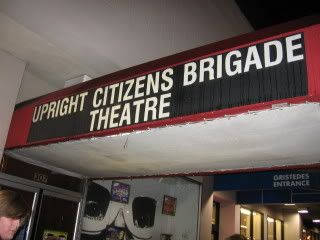
Week three of Sketch Comedy 101 at the Upright Citizens Brigade. Conversation between class members seemed easier. And then someone blurts out to our teacher, Charlie, "See, we're talking." This of course killed the whole good buzz that was happening. Luckily we got it back as the sketches again this week were very good. This week's assignment involved creating a character sketch. There are a lot of interesting folks in this world - so many that at some points in my life I've begun to wonder if those people are normal and I'm a bit left of center. Unfortunately, my memory was failing me badly this weekend. I couldn't think of a single funny character to write about. Last week the other sketches were so good, and mine was certainly not, that I felt an intense pressure to write something hilarious. I wracked my brain for ideas, started to go down a path, and realized all roads were heading toward decidedly un-funny destinations. I was explaining the situation to my friend, Kelly, whom I was visiting in Buffalo over the July 4th weekend.
I threw out an idea of a Brain Storming Session Gone Wrong. I'm intrigued by how often that term is thrown around in some companies by senior management. I thought it might be funny to have a CEO who's the least creative person on the planet running a session with his highly creative direct reports, and then shoot down all of their ideas in favor of his own lunatic suggestions. Kelly agreed that that could be a fun sketch, that it probably happens to people more often than not, and I could make a go of it.
So I did and it was funny. Very funny. So funny in fact that the man reading the CEO character was laughing too hard to get the lines out. This was a good sign for my writing and a vast improvement over last week. And then other people in the class were joining in with new ideas to heighten the comedy even more. Now I know why writers enjoy this form.
Here's the learning: Take a cue from the very idea of brainstorming sessions and put every idea out there. I've suggested many ideas that fell flat once I put them out into the world. I've kept my suggestions to myself only to have someone else say the same exact idea and get a big laugh. And I've made some suggestions that don't sound all that funny to me though once I get them out into the world, they go over well.
Comedy, more than any other art form I've experience, is a living, breathing entity. You know immediately whether or not it's good because laughter, in the best possible case, is uncontrollable by our conscious minds. We have no idea if something is funny until we act it out for others and gauge their response. It requires that we ban together with other people to create something valuable; a good lesson to consider, with far deeper impact on our lives than just the act of writing sketch comedy.
Next week, we're scheduled to present commercial parodies. With all of the good fodder out there on the airwaves now, the trouble will be deciding among dozens of choices which one will be most likely to get the biggest laughs.
Monday, July 7, 2008
Nothing Worse Than Silence

I started a Sketch Comedy Writing class knowing I'd be the least funny of the students. Part of my motivation was to meet writers, and I figured all of us could use a little more humor in our lives and in our writing. We write every week and then read our work out loud for everyone to hear.
My first piece was too short and not at all as funny as I had hoped it would be. I got a few polite smiles, and maybe one line that got a true laugh. Otherwise, it fell flat. To be fair, the class is relatively quiet - I'm assured by our instructor that ALL sketch writing classes are quiet. But if that's the case then I'm having a hard time understanding why he brings that fact to our attention several times per class. Every other sketch piece was far funnier than mine.
Part of me just wanted to throw in the towel. And then I thought of my friend, Brooke, who has recently transitioned from stage acting to TV / film. She's studied TV and film with conviction for nearly a year. And she goes to auditions not with the intention to book a job, but to improve, to feel that her investment of time in learning this new art form is worthwhile. Some people are naturally funny in that Saturday Night Live sort of way. I'm not -- I'm going to have to work at it. And the good news is, well, I really have nowhere else to go but up.
I'm in the middle of preparing my next piece - a character sketch. Time to dig out the memories of all those weirdos I've had the privilege to meet...they're finally coming in handy.
Friday, June 20, 2008
The hard work of simplicity

I have been working on a few projects that require one simple thing: simplicity. While we crave it, work for it, buy all kinds of books and gadgets that claim to be able to make our lives simple, simplicity often alludes us. Recently, I sat with a team member to craft a memo. She kept adding, and adding, and ADDING to it. Finally I said, "Stop. Turn away from the computer. Tell me what you want to say." She could articulate her ideas well when speaking to me and the moment she sat at the computer, she hid behind an excess of words.
I found a quote later that day that gets at the very essence of good writing, and solid editing. "The ability to simplify means to eliminate the unnecessary so that the necessary may speak. ~ Hans Hofmann." And that's it in a nutshell - that is the motivation of every writer, and every editor, in one succinct sentence. To get to the diamond, you need to polish it, and that means removing the unnecessary layers.
It's easy to understand why we think simplicity should be simple. It's not - it's an art that must be practiced. It can be painful. Simplicity is work. We are complex creatures - emotions, biases, past experience, and a deep need to be understood all stand in our way. The work of an editor is to clear the path. To soothe emotions and biases, while preserving and honoring history and the ability for us to influence and affect one another.
As a quick guide, I do the following four things when I feel simplicity getting away from me:
1.) I audibly articulate the nugget of truth I am trying to convey. And then I write it down verbatim. I start from there.
2.) I eliminate every word I can without losing the sentiment I want to convey. This can mean many different types of rework: from restructuring a sentence to finding a descriptive word that can speak for a number of smaller words.
3.) I step away from the writing, even just for a few minutes. Sometimes to get out of the hairball in our writing, we have to physically step away from it.
4.) I only write when I am crystal clear about my motivation for writing, the channel I am writing for (print, blog, brochure, presentation, etc.), and the audience I am trying to reach. This is the framework on which we hang every word.
Wishing you simplicity and good editing, in writing and in life!
Graphic above found at http://www.simpledorm.com/images/simple.gif
Thursday, April 10, 2008
The occupational hazard of blogging and other creative outlets
I feel terrible for the families and friends of these writers, the oldest of which was only 60. It is always tragic to see anyone consumed by what they love. I read the article closely, several times, and there are a few things that on the surface I feel may have saved these people. I hope by sharing them with you that they may help other people who feel obsessed with their jobs for whatever reason.
I completely understand insomnia - I've suffered with it for most of my life. I understand anxiety about money - I grew up in a family with very little, and only recently have been able to breath a bit easier about my finances. There were a few huge things in my life that have made a difference in my level of anxiety - I consciously decide to not be a workaholic, and I practice yoga every day, no matter how short an amount of time.
When I worked in DC, some of my office mates would make fun of me because at 5:30, nearly every day, I was out the door. I would feel angry about their teasing sometime, though most of the time I let it go. My mom works herself to the bone. I mean to the absolute brink. It was painful for me, as a kid, to watch her. A year and a half ago, she was diagnosed with breast cancer, and from her recovery bed, she was on her computer. Some call this dedication. There's no denying my mom is a dedicated woman; unfortunately, she is dedicated to a fault. A very large fault, that very easily could cost her, and her children, her life.
Even today, I will come in early, I will work on things at home at night, but I never, and I mean never, allow myself to fall into the habit of staying in the office past 5:30. On occasion, I get it - deadlines pop up, and an occasional late night is necessary. When I went looking for a job after business school, I was adamant about finding one that afforded me a life and time to live it. This is a conscious choice - I ALWAYS have more work, I could always be doing more. I choose to let it lie for the next day. I could very easily become a workaholic; it's in my blood. I fight that temptation every step of the way, and I refuse to back down in the face of my impulse to work "just a little bit more".
Yoga, quite honestly, saved my life. It helped me forgive a lot of sadness and disappointment. It helped me cope during times of extreme stress. It gave me the strength to get up, again and again, with an open heart. It is a discipline. After years of practice, I can sleep, in relative peace. And when I can, where I can, I am out in the world singing yoga's praises, sharing my knowledge about it. Everyone needs a healthy release - yoga is mine.
Anything in the world can get the best of you - food, drugs, gambling, smoking, love, an obsessive hobby, and yes, work, no matter what field you're in. You have more control over you than anyone in the word, whether you realize it or not. At every moment we have a choice. If we are doing something, anything, that harms us, it's easier to blame someone else. Our boss, our romantic partner, our friends. The truth is others control us when we allow them to. Ultimately, our happiness, the very activities that compose our lives, are all choices. And choosing what to do among many options is the hardest, and most important, task we have. I consciously remind myself every morning that my time is the most valuable resource in the world, and I treat it accordingly.
Sunday, March 2, 2008
A life in pictures
I've been impressed with The New Yorker's Cartoonist of the month blog. February chronicled the journey of Michael Maslin as he made his way as a cartoonist. After pouring through his favorite publications, The New Yorker in particular, he would submit idea after idea and would be rejected continuously.