
"The purpose of this course is to awaken the restlessness of reason, and if we have done at least that, and restlessness continues to afflict you in the days and years to come, then we together have achieved no small thing." ~ Michael Sandel
Michael Sandel's online class at Harvard, Justice, ended a few weeks ago. Over the course of the semester it became my weekly ritual every Thursday to watch the class via YouTube and then participate on the online forum. I will admit that I miss the class. Professor Sandel has a way of creating restlessness, discomfort, in his students that keeps them pondering his points and those of the philosophers he highlights long after the class ends. He inspires curiosity.
It's this inspiration that keeps teachers going. I consider some of my very best teachers, inside and outside the classroom, and everything that they did to help me get far beyond my circumstances. The best of them didn't have all the answers. They just had more questions. Beautiful, articulate questions that made me restless. Questions that still keep my restless, years and years later. It's this restlessness, and the ideas that cause it, that expand our visions. These ideas imagine what's possible rather than accepting what's probably. They push boundaries; they build dreams.
In addition to inspiring curiosity, my teachers also inspired me to aspire. Not for a title or a certain amount of money or power or influence. They inspired me to aspire to get every last drop of value out of this one life that I have. They poured a lot of grace into my dreams so when I consider what I'll do with my time, it isn't just my own days that I need to live to the fullest. Reaching and then exceeding my potential isn't just about my own sense of achievement. I live part of my dreams for them, too. For all of them. It is a responsibility that I willingly, gladly accept because grace is a terrible thing to waste.
Showing posts with label justice. Show all posts
Showing posts with label justice. Show all posts
Wednesday, December 16, 2009


Sunday, June 28, 2009
My Year of Hopefulness - Gay Pride
 Today marks the 40th anniversary of Gay Pride. Last night, I went to the movies with my friends, Thomas and Richard, a couple who have been together for 24 years. After the movie, we walked over to the Christopher Street subway stop to head back uptown. Before getting on the subway, we went by the Stonewall Inn. Richard explained the history and significance of the Inn to me and how it served as the stage for the tipping point of the gay rights movement in what would become known as the Stonewall Riots.
We enjoyed watching the crowd in the neighborhood, and read the newspaper clippings and admired the replica of Judy Garland's Wizard of Oz dress in the window of the Stonewall Inn. (Judy Garland, a hugely popular gay icon, died several days before the Stonewall Riots began and her funeral was held the day before the riots.) It's important to bear witness, to remember how difficult and frightening a time was for people courageous enough to stand up for themselves. And while it's easy to consider how far we still have to go on certain human rights issues such as gay marriage, it's equally important to celebrate how much has been accomplished in the 40 years since Stonewall.
In New York State, we are on the cusp of legalizing gay marriage. If passed, we'd be the 7th state to legalize gay marriage. Gay marriage and the equal treatment of gay Americans is the civil rights issue of our time. I am certain that decades from now, we will look back on this period as one of embarrassment and shame. I cannot fathom how anyone would deny the basic rights of another human being based on their sexuality. Are the movements that led to equal treatment of women and ethnic minorities any different than what the gay community now faces? If two gay people want to get married, what bearing does that have on two straight people who are married? Who are we to stand in judgement of someone else's lifestyle?
I hope the concept of denying gay marriage never makes sense to me. I hope to never understand why a portion of the straight population is so convinced that the gay population is ruining the sanctity of marriage. What I do hope happens is that the very politicians and their supporters who are fighting so hard against gay marriage, the same ones who are so quick and earnest to dismiss their own issues of infidelity, will find a way to see the world and the rights of all people through new eyes.
I hope that someday we will look at all people as equal, gender, sexual orientation, race, and religious beliefs aside. I hope that someday very soon, my gay friends are afforded the same right to union and happiness that my straight friends and I have. I hope that very soon the gay rights movement becomes something for history books - a time that we collectively look back on, and shakes our heads in wonder, asking "why did it take so long for simple justice?"
The photo above was taken from: http://sunfollower.wordpress.com/2009/01/09/civil-rights-movement-the-stonewall-riots/
Saturday, June 20, 2009
My Year of Hopefulness - Human Rights Watch Film Festival
 "My favorite place is my imagination." ~ Jackie Pagan, featured narrator in Youth Producing Change
My friend, Linda, invited me to the Human Rights Watch film festival here in New York at Lincoln Center's Walter Reade Theatre. We went to see Youth Producing Change, a documentary created from the stories of 10 young film makers on issues ranging from youth homelessness to HIV / AID to water conservation. The stories are deeply moving, and all the more remarkable because they were made by film makers under 18 years old, many from impoverished countries who belong to marginalized populations.
How often do we catch ourselves saying, "how can I make a difference?" or "what change can I really achieve in this complicated world?" We had the great privilege to have a question and answer session with the film makers after Youth Producing Change had its screening. The producers don't ask themselves these questions. They have gone confidently in the direction of their dreams, believing now only that they can have an impact, but rather that it is their obligation and their duty to create change.
Most times, young people are told to respect their elders, to follow the lead of adults, to learn from their mentors. Sitting in the Walter Reade Theatre today, I found that these young adults have much more to teach us than we have to teach them. They have seen, heard, and experienced life in a way that is very difficult for most of us to even imagine; the vivid images and language of the documentary give us a frame of reference that is critical to build our empathy and compassion for the human experience. Thankfully, their stories are the stuff of movies now, and we should do our best to nurture, support, and encourage their drive, ambition, and courage to tell their stories.
Youth Producing Change will be screened in high schools across the U.S. and was shown at the festivals in Chicago, Toronto, San Francisco, and London. The Human Rights Watch film festival continues in New York through June 25th.
Tuesday, April 21, 2009
My Year of Hopefulness - Harvey Milk
 At 40 years old, Harvey Milk sat in a gray New York City cubicle at a large insurance company. He wasn't proud of a single one of his accomplishments. Luckily for all of us, Harvey Milk was not content to live out his days in an unremarkable fashion. He rose up, and he took us with him.
In the remarkable portrayal of the first openly gay elected official in the U.S., Sean Penn brought the story of Harvey Milk to a new generation of people, just as the tide of activism, volunteerism, and interest in politics was taking hold again in this country. Harvey Milk stands as a shining example of possibility realized, of personal accountability and responsibility, of the power of a single individual to unite a group of people for a common cause.
Harvey Milk's story is especially important now as we consider and re-consider laws and propositions whose central issue is decency and respect and dignity. Someone's sexual orientation, gender, cultural heritage, religion, race, and socioeconomic status too often determines the course of someone's life in our country. And it must stop.
I've heard people say that every generation has its own societal ill that becomes central to its history, shaping the lives of its members going forward. Ours is very basic, very easy to articulate. Once and for all, are we going to support the notion that all humans should be treated humanely, regardless of circumstance? Will we finally make the statement "all people are created (and therefore treated) equal" a reality? If so, then all of Harvey Milk's efforts, and the efforts of millions like him, will have all been worthwhile.
Thursday, April 2, 2009
My Year of Hopefulness - American Violet
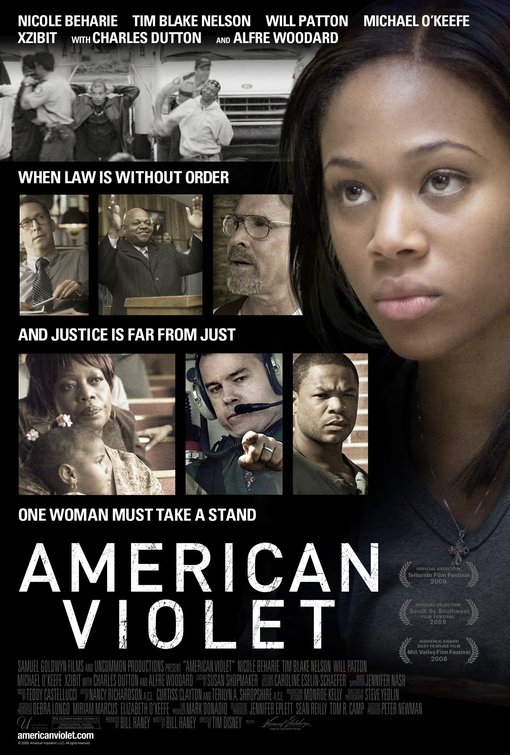 Tonight, I went to the New York screening of American Violet, a movie about an ACLU case in Texas against a District Attorney for racial profiling in drug cases. I was skeptical about the movie. I was worried about it being preachy and over-dramatic, though my friend, Richard, invited me, and I wanted to support him and his organization. And I couldn't have been more wrong. The movie is stunning.
 This movie showcases activism at its best. A young woman takes on the case as the lead plaintiff with the encouragement from the ACLU to stand up for her community, her neighbors, and her family. Wrongfully convicted of selling drugs in a school zone, she endures great pain and difficulty in the name of what's right. She displays so much courage that had a I not known it was based on a true story, I would have believed it was invented in Hollywood.
A complete surprise, the woman whom the story is based on was there in the audience and spoke after the movie. Her eloquence and grace in the face of such trying circumstances is so inspiring that I left wondering how on Earth I could ever complain about anything in my life. While many people have given their lives to stand up for justice, the main character of American Violet didn't have a choice. Injustice was her life, and the life of those all around her. If she wanted to live free, truly free, and move forward she had to stand up. She had no choice but to fight.
American Violet is a testament to the power of story-telling and narrative, the ability to connect people across miles and circumstances, despite age, race, culture or gender. Stories, and their telling and retelling, build empathy and strength. Films about social issues have the ability to entertain and inform; they build community. And to solves problems as large as the issues of racism and substance abuse and incarceration, we need community.
As I walked back to my apartment, I was reminded of Anne LaMott's book Bird by Bird, my favorite book about writing and story telling. At one point in the book, Anne talks about the writing classes she teaches in the Bay Area. And her one piece of advice to her students that I always think about revolves around courage in writing. If you have the courage to live through a tough situation and free yourself, then have the courage to write it down and share it with others because in telling your story, you just might help set someone else free. I can't imagine a more beautiful example of that principle than American Violet. Opens in theatres everywhere April 17th.
Subscribe to:
Posts (Atom)

